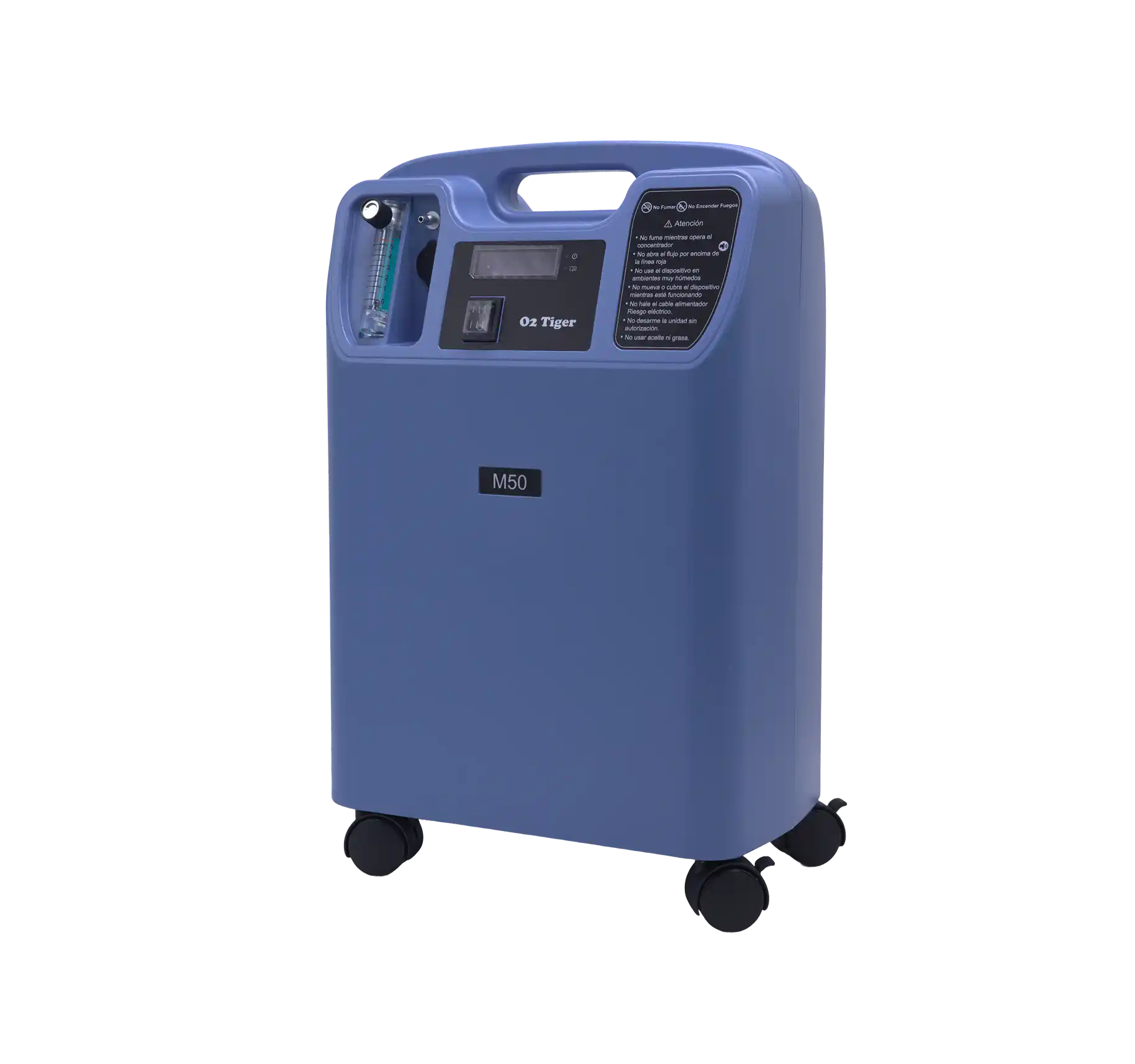
O2 Tiger M50
Compact and efficient 5-liter oxygen concentrator that offers low-noise performance with high-purity output, making it ideal for long-term oxygen therapy.
Key Features:
- Delivers 1–5 LPM with consistent oxygen purity of 93% ±3% at 5 LPM.
- Lightweight 14.2 kg design.
- Energy-efficient operation with low power consumption (300W).
- Quiet performance with noise level as low as 45 dB.



Right-Sized 5L for Homecare Fleets
The O2 Tiger M50 is a 5-liter stationary oxygen concentrator designed for patients with moderate hypoxemia requiring continuous supplemental oxygen at flow rates of 1–5 LPM. At 14.2 kg and 300W power consumption, it is significantly lighter and more energy-efficient than 10-liter models, making it easier to transport and more cost-effective to operate.
For institutional buyers managing large homecare fleets, the M50 is the right-sized choice for the majority of oxygen therapy patients. Most prescriptions fall within the 1–5 LPM range, meaning the M50 covers the high-volume segment at a lower per-unit cost than 10L concentrators — freeing budget for the smaller number of higher-acuity patients who need the OT-Star 10.
Why Institutional Buyers Choose the O2 Tiger M50
Right-sized for the majority of oxygen therapy prescriptions — optimizing fleet cost without compromising clinical output.
Right-Sized for Most Prescriptions
Most oxygen therapy prescriptions fall within 1–5 LPM. The M50 covers this majority segment at a lower per-unit cost than 10L concentrators, optimizing fleet procurement budgets.
Lighter, Easier to Deploy
At 14.2 kg (vs. 26 kg for 10L units), the M50 is easier for delivery teams to transport and install — reducing logistics costs across distributed patient populations.
Energy-Efficient for Patients
300W power consumption means lower electricity costs for patients. A meaningful consideration in LATAM markets where patients bear utility costs and power reliability varies.
Frequently Asked Questions
How loud is the O2 Tiger M50 during operation, and is it suitable for bedroom use?
The M50 operates at 45 dB — comparable to a quiet library or a modern refrigerator. For an oxygen concentrator, this is notably quiet. Many competing 5L concentrators run at 50–55 dB, where the additional 5–10 dB represents a meaningful increase in perceived loudness.
At 45 dB, the M50 is viable for overnight bedroom use without significantly disrupting sleep for patients or household members. This matters because most LTOT patients use their concentrator during sleep — if the device is too loud, compliance drops or patients disconnect at night (exactly when oxygen desaturation events are most dangerous). For homecare distributors, the noise spec is a competitive differentiator when presenting to patients who've previously rejected louder devices.
At 14.2 kg, is the O2 Tiger M50 portable enough for home use?
The M50 weighs 14.2 kg, which makes it one of the lighter stationary 5L concentrators on the market. For reference, the Philips EverFlo weighs 14.0 kg and the Invacare Perfecto2 weighs 15.9 kg. The M50 is competitive on weight with the established market leaders.
"Portable" needs qualification: 5L concentrators are stationary home devices, not travel equipment. They're designed to sit in a bedroom or living room and provide continuous oxygen therapy. At 14.2 kg, the M50 is light enough for a patient or caregiver to move between rooms, but it's not intended for transport outside the home. For ambulatory oxygen needs, patients would use a portable oxygen concentrator (POC) or compressed oxygen cylinders. The M50's compact footprint fits on a nightstand or small table without dominating the room.
What oxygen purity does the O2 Tiger M50 deliver, and at what flow rates?
The M50 delivers 93% ±3% oxygen purity at its maximum flow rate of 5 LPM (liters per minute). Purity remains stable across the full 1–5 LPM range, making it suitable for patients prescribed continuous low-flow oxygen therapy.
For context, 93% ±3% meets the ISO 80601-2-69 standard for oxygen concentrators and falls within the therapeutic range for most long-term oxygen therapy (LTOT) prescriptions. The concentrator uses molecular sieve technology (pressure swing adsorption) to separate oxygen from ambient air — no tanks, no refills, no delivery logistics. For distributors serving homecare providers and hospital discharge programs, the M50 covers the majority of LTOT patients who need 1–5 LPM continuous flow.
What maintenance does the O2 Tiger M50 require, and how often should filters be replaced?
The M50 requires minimal maintenance: external air intake filter cleaning every 2 weeks (rinse with water, air dry) and filter replacement every 3–6 months depending on ambient air quality. In dusty environments or high-pollution cities, replacement frequency should increase.
The molecular sieve beds that produce oxygen are designed for 10,000–20,000 hours of operation before efficiency degrades — that's 2–4+ years of continuous 24/7 use. When the sieve beds eventually need replacement, it's a serviceable component, not an end-of-life event. SysMed stocks replacement filters and sieve beds in Miami for LATAM fulfillment. For DME providers and homecare companies, the low maintenance burden reduces service call frequency and keeps operating costs predictable for patients on long-term therapy.
How much electricity does the O2 Tiger M50 consume, and what does that cost to operate?
The M50 draws 300W — significantly less than older concentrator designs that commonly pull 350–450W. Running 24/7 at 300W, the monthly electricity cost ranges from approximately USD $15–40 depending on local electricity rates across LATAM markets.
This efficiency matters in two specific scenarios. First, in markets with high or subsidized electricity costs (Argentina, Uruguay), operating cost directly affects whether patients can afford to run the device continuously as prescribed. Second, in areas with unreliable power grids, lower wattage means the M50 can run longer on backup battery/UPS systems during outages — a genuine safety consideration for oxygen-dependent patients. For distributors, the 300W spec is a selling point that addresses both cost objections and infrastructure reliability concerns.